The India–UAE Comprehensive Economic Partnership Agreement (CEPA) has completed four years as a landmark trade pact transforming bilateral commerce and opening new global opportunities for Indian exporters. Since coming into force in May 2022, CEPA has accelerated trade growth, reduced tariff barriers, and enabled faster market access to one of the world’s most strategic trade hubs — the UAE.
For Indian businesses, especially MSMEs and emerging exporters, CEPA has become a powerful catalyst for export expansion, competitiveness, and global partnerships.
Understanding India–UAE CEPA
The Comprehensive Economic Partnership Agreement (CEPA) between India and the United Arab Emirates was signed on 18 February 2022 and came into force on 1 May 2022. It is a comprehensive agreement covering trade in goods and services, customs procedures, investment cooperation, digital trade, and regulatory frameworks to deepen economic integration between the two nations.
Strong Trade Growth Since CEPA
Over the past few years, CEPA has delivered measurable economic outcomes:
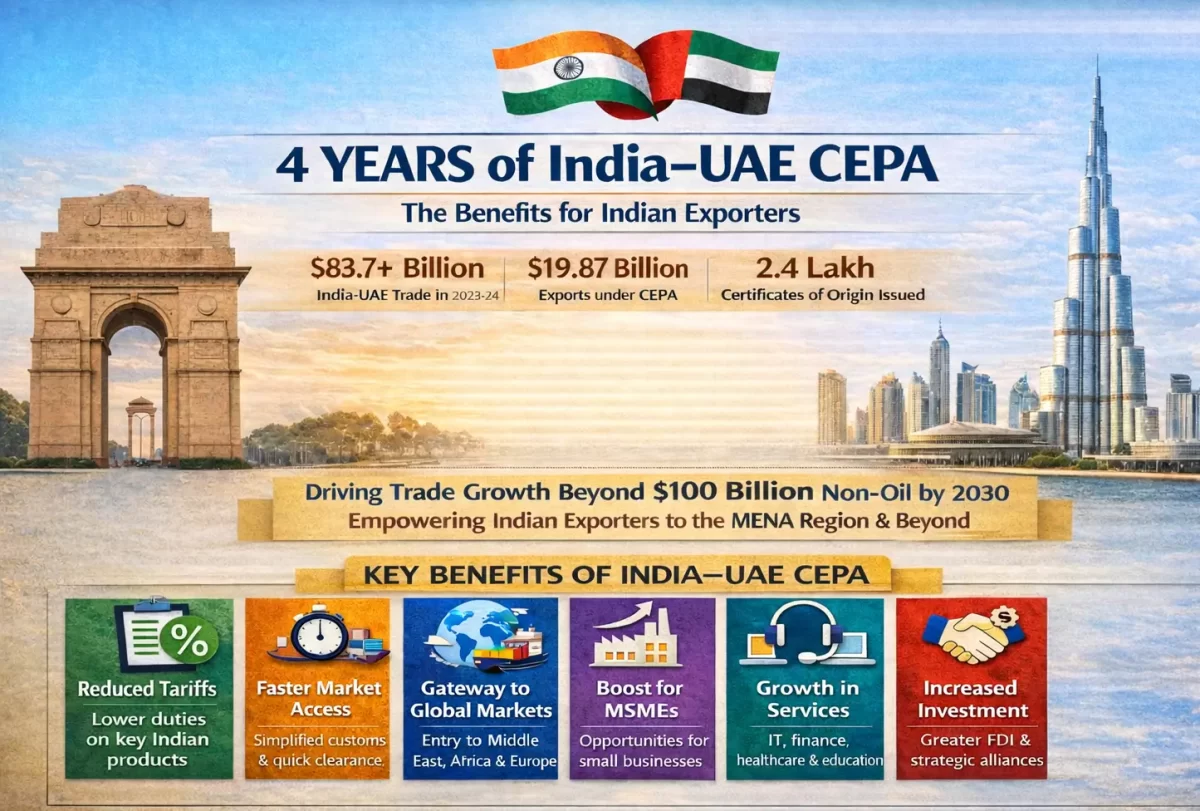
- Bilateral merchandise trade nearly doubled from USD 43.3 billion in FY 2020–21 to USD 83.7 billion in 2023–24
- Trade reached around USD 80.5 billion by January 2025
- Non-oil trade rose to USD 57.8 billion, accounting for more than half of total trade
- Nearly 2.4 lakh Certificates of Origin were issued, supporting exports worth USD 19.87 billion to the UAE
These numbers clearly demonstrate CEPA’s effectiveness in expanding trade volume and diversifying export baskets.
Key Benefits for Indian Exporters
1. Reduced or Eliminated Tariffs
CEPA has significantly lowered or eliminated customs duties on a wide range of Indian products exported to the UAE. This has allowed Indian exporters to improve price competitiveness and expand market share across key sectors such as textiles, gems & jewellery, engineering goods, chemicals, and agriculture-based products.
Duty elimination on a large portion of tariff lines has especially benefited labour-intensive industries, improving export viability and profitability.
2. Faster Market Access and Trade Facilitation
The agreement has simplified customs procedures, reduced non-tariff barriers, and streamlined documentation requirements. Exporters now benefit from faster clearance timelines, better predictability in trade processes, and smoother logistics coordination — enabling quicker response to international demand.
3. Gateway to MENA and Global Markets
The UAE serves as a global re-export hub connecting markets across the Middle East, Africa, and Europe. By leveraging CEPA, Indian exporters can enter the UAE and subsequently expand into wider regional markets without establishing separate entry channels for each country.
This multiplies the reach of Indian exports and supports long-term global market diversification.
4. Boost to MSME Export Participation
CEPA has empowered Indian MSMEs by lowering entry barriers and making exports more accessible. The agreement has generated new business opportunities, supported employment creation, and strengthened the participation of smaller enterprises in global trade.
MSMEs can now:
- Export competitively with reduced duties
- Access distribution networks in the UAE
Scale their international presence gradually
5. Enhanced Opportunities for Service Exporters
CEPA has opened significant opportunities for Indian service providers across sectors such as IT, financial services, healthcare, consulting, education, and professional services. The agreement provides access to multiple service subsectors, enabling Indian firms to expand their service footprint in the UAE market.
6. Increased Investment and Business Collaboration
CEPA has encouraged cross-border investments, joint ventures, and strategic partnerships between Indian and UAE companies. It has created new avenues for collaboration in manufacturing, logistics, fintech, education, and innovation-driven sectors, strengthening long-term market integration.
7. Alignment with India’s Export Growth Vision
The success of CEPA aligns closely with India’s broader export growth strategy. The agreement is expected to help scale bilateral non-oil trade towards the USD 100 billion target by 2030, supporting diversification of India’s export markets and integration into global supply chains.
By promoting MSME participation, job creation, and new business opportunities, CEPA directly contributes to India’s ambition of significantly expanding exports over the coming decade.
Challenges and the Way Forward
While CEPA has delivered strong gains, exporters must continue to focus on:
- Compliance with Rules of Origin requirements
- Understanding UAE regulatory and certification norms
- Strategic product positioning and branding
Greater awareness, training, and institutional support will further enhance CEPA utilization among MSMEs.
Conclusion
Four years of the India–UAE CEPA demonstrate how a well-structured trade agreement can translate policy into tangible business growth. With tariff reductions, faster market access, and expanding opportunities in goods and services, CEPA has empowered Indian exporters to compete more effectively on the global stage.