Exporting goods is often seen as the gateway to global business growth. Yet behind every successful international shipment lies a structured system of documentation that ensures legal compliance, smooth customs clearance, and secure financial transactions.
Export documentation may appear complex at first, but it essentially serves one key purpose: to ensure that all stakeholders involved in international trade—exporters, importers, customs authorities, logistics providers, and banks—have a clear and verified record of the transaction.
For Indian exporters, proper documentation is not just a procedural formality. It is the backbone of cross-border trade and a critical factor in avoiding shipment delays, penalties, or payment disputes.
Why Export Documentation Is Important
International trade involves multiple jurisdictions, regulations, and stakeholders. Export documentation helps streamline this complexity by ensuring transparency and accountability.
Some of the primary functions of export documentation include:
Regulatory Compliance
Export documentation ensures that shipments comply with regulations set by authorities such as the Directorate General of Foreign Trade (DGFT) and Indian Customs.
Customs Clearance
Customs officials rely on export documents to verify product classification, value, origin, and destination before allowing goods to leave the country.
Logistics Coordination
Shipping lines, airlines, and freight forwarders use these documents to handle cargo efficiently during transit.
Financial Security
Banks rely on export documents to process international payments, especially when the transaction involves instruments such as a Letter of Credit (L/C).
Without accurate documentation, even a fully prepared shipment can remain stuck at the port.
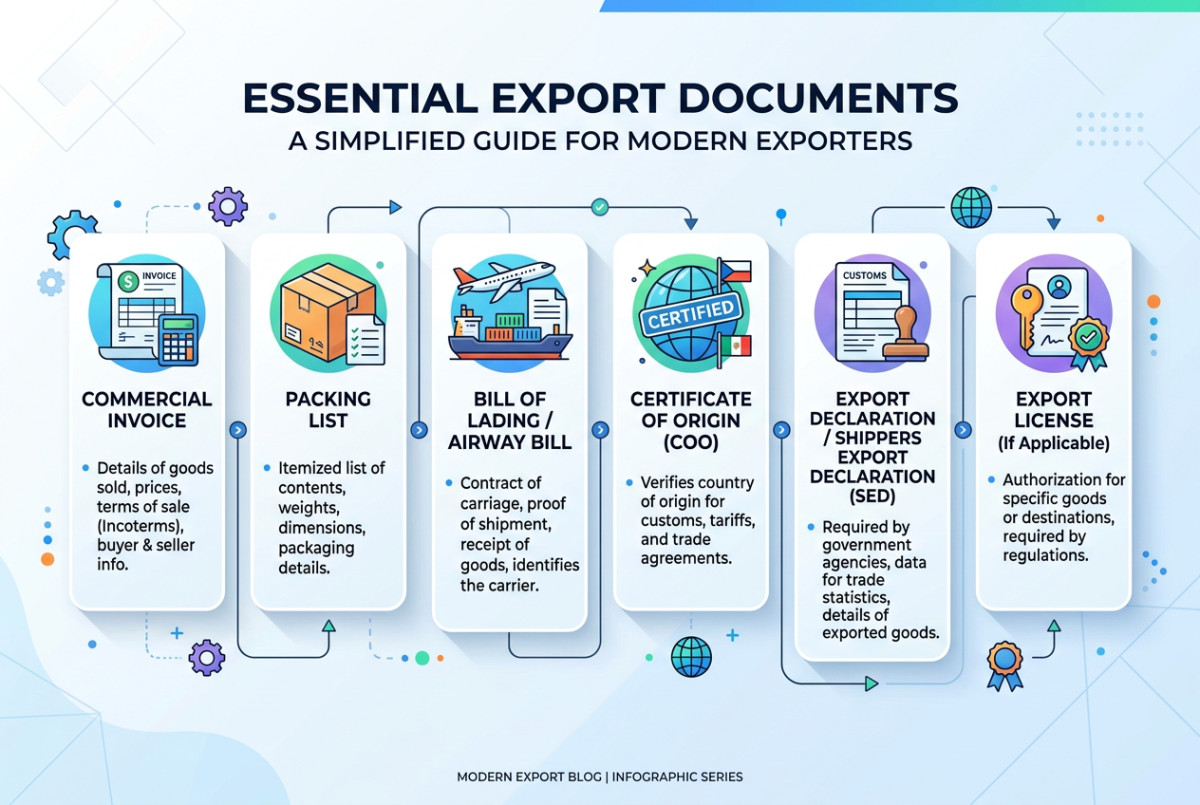
Key Export Documents Every Exporter Should Know
1. Proforma Invoice
The Proforma Invoice is usually the first formal document issued by the exporter to the overseas buyer. It acts as a quotation in invoice format and outlines the proposed transaction details.
Typically, it includes:
- Description of goods
- Quantity and price
- Delivery terms (Incoterms)
- Payment terms
- Estimated shipment schedule
Buyers often use the Proforma Invoice to apply for import permits, arrange financing, or open a Letter of Credit with their bank.
2. Commercial Invoice
The Commercial Invoice is the final invoice issued once the sale is confirmed and goods are ready for shipment.
This document serves as the official record of the transaction and includes:
- Exporter and importer details
- Description of goods
- Unit price and total value
- Currency of transaction
- Payment terms
Customs authorities in both exporting and importing countries use this document to determine duties and taxes.
3. Packing List
The Packing List provides detailed information about the packaging of the shipment.
It typically includes:
- Number of packages
- Dimensions and weight
- Type of packaging (cartons, pallets, crates)
- Package markings
Although it does not contain price information, it is essential for customs inspections and cargo handling by logistics providers.
4. Bill of Lading (B/L) or Airway Bill (AWB)
The Bill of Lading (B/L) is issued by the shipping line for sea shipments and plays a crucial role in international trade.
It serves as:
- A receipt confirming that goods have been loaded
- A contract between the exporter and the carrier
- A document of title to the goods (in negotiable B/L cases)
For air shipments, an Airway Bill (AWB) is issued by the airline. Unlike a Bill of Lading, an AWB is typically non-negotiable.
5. Shipping Bill (India’s Key Export Document)
In India, the Shipping Bill is the primary document required for customs clearance of export shipments.
Exporters or their customs brokers file this document electronically through the ICEGATE portal, which is the online interface for Indian Customs.
The Shipping Bill contains details such as:
- Exporter information
- Product classification (HS Code)
- Quantity and value
- Destination country
- Export incentive scheme details (if applicable)
Once customs authorities approve the Shipping Bill, goods can be loaded for export.
6. Certificate of Origin (CoO)
The Certificate of Origin confirms the country where the goods were produced or manufactured.
This document is particularly important because:
- Import duties may vary depending on the origin of goods
- Some countries offer tariff benefits under Free Trade Agreements (FTAs)
In India, Certificates of Origin are typically issued by export promotion councils and chambers of commerce.
7. Export License (When Required)
Most goods can be exported freely from India. However, certain products require an export license or special authorization.
These may include:
- Restricted or controlled chemicals
- Defense-related equipment
- Certain agricultural or wildlife products
Exporters must verify licensing requirements through the DGFT export policy schedules before shipping goods.
8. Insurance Certificate
The Insurance Certificate provides proof that goods are insured during transit against risks such as loss, damage, or theft.
Responsibility for insurance depends on the Incoterms agreed between the buyer and seller.
For example:
- Under CIF (Cost, Insurance and Freight), the exporter arranges insurance.
- Under FOB (Free on Board), the importer typically arranges insurance.
9. Letter of Credit (L/C)
A Letter of Credit is a widely used payment mechanism in international trade.
It is issued by the buyer’s bank and guarantees that the exporter will receive payment once the required shipping documents are presented and verified.
This mechanism reduces risk for both parties and is especially useful when trading with new buyers or unfamiliar markets.
10. Customs Declaration
The Customs Declaration provides authorities with information about the nature and value of exported goods.
In India, this information is largely integrated into the Shipping Bill filed through the ICEGATE system.
Customs authorities use this data to monitor trade flows and ensure regulatory compliance.
11. Inspection Certificate
In some cases, buyers or governments require a third-party inspection certificate confirming the quality or quantity of goods before shipment.
Independent inspection agencies such as SGS, Bureau Veritas, and Intertek often conduct these checks.
Such certification adds credibility and helps prevent disputes between buyers and sellers.
12. Export Packing List (Detailed Version)
For large or complex shipments, exporters may prepare a more detailed Export Packing List.
This document provides additional details such as:
- Item-wise packaging breakdown
- Carton or pallet numbers
- Internal contents of each package
This level of detail helps customs authorities and importers verify shipments quickly.
13. Dangerous Goods Certificate
If the shipment includes hazardous materials, exporters must comply with international safety regulations.
A Dangerous Goods Certificate confirms that the cargo has been packed, labeled, and handled according to regulations such as:
- IMDG Code for sea transport
- IATA Dangerous Goods Regulations for air shipments
Common Documentation Mistakes Exporters Should Avoid
Even experienced exporters occasionally face delays due to documentation errors. Some common mistakes include:
- Incorrect HS codes
- Mismatched values between documents
- Incomplete consignee details
- Errors in Incoterms or shipment terms
- Missing certificates required by the importing country
Ensuring consistency across all documents is essential for smooth customs clearance.
Final Thoughts
Export documentation may appear bureaucratic, but it plays a crucial role in ensuring that global trade runs smoothly. Properly prepared documents help goods move seamlessly across borders, reduce financial risks, and build trust between trading partners.
For Indian exporters aiming to expand globally, mastering export documentation is not just about compliance—it is about building a reliable and scalable export operation.In international trade, documentation is not merely paperwork.
It is the foundation of trust, compliance, and efficiency in global commerce.