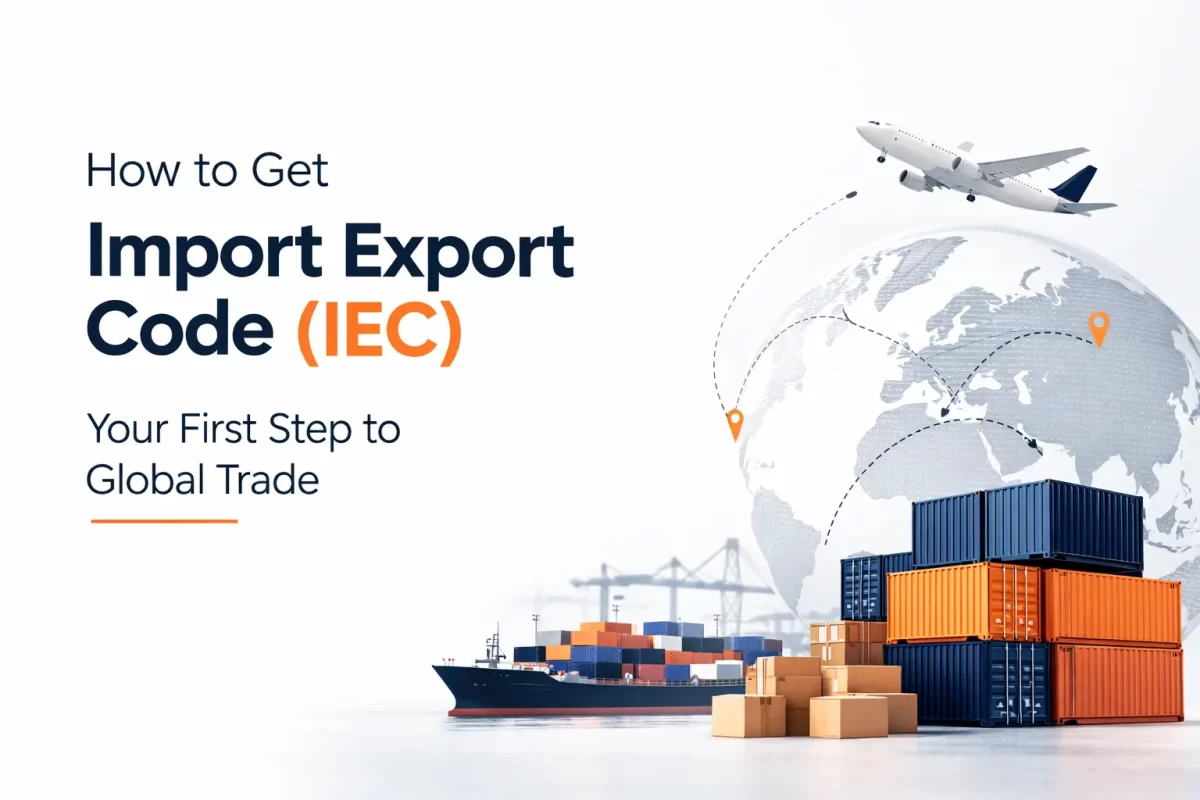
For many entrepreneurs in India, the idea of selling products beyond borders is exciting. Whether it’s spices, handicrafts, textiles, or modern manufactured goods, global markets offer immense opportunities. But before your products can travel overseas, there is one important requirement you need to take care of — the Import Export Code (IEC).
Issued by the Directorate General of Foreign Trade (DGFT) under the Ministry of Commerce and Industry, the Import Export Code is essentially a 10-digit identification number that allows businesses in India to legally import or export goods and services.
Think of it as your passport for international trade. Without it, shipments cannot clear customs, and banks will not process international payments related to trade.
The good news? Getting an IEC today is far simpler than it used to be.
Why the IEC Matters
Imagine you have built a great product and finally receive an inquiry from a buyer in another country. The deal looks promising, the pricing works, and everything seems ready to move forward. But when it comes time to ship the goods, the process suddenly stops because your business does not have an IEC.
Customs authorities require this code to process export or import shipments. Banks also ask for it before allowing foreign currency transactions related to trade. In short, without an IEC, international trade simply cannot happen.For this reason, most exporters consider IEC registration the very first formal step in their export journey.
Who Needs an IEC?
Almost anyone planning to participate in international trade must obtain an IEC. This includes:
- Individual entrepreneurs
- Proprietorship businesses
- Partnership firms
- Limited Liability Partnerships (LLPs)
- Private Limited companies
- Public Limited companies
- Trusts and societies engaged in trade
Even individuals exporting services or products online may require an IEC if they receive payments from overseas buyers.The rule is simple: if your business is involved in cross-border trade, an IEC will likely be required.
The Documents You’ll Need
One of the reasons IEC registration is popular among new exporters is that the documentation requirement is minimal. In most cases, the application can be completed with just a few basic documents:
- PAN card of the individual or business entity
- Aadhaar card for identity verification
- Address proof of the business location
- Bank account details, typically a cancelled cheque
- A passport-sized photograph
Since the entire application process is digital, these documents are uploaded directly on the portal.
How the Application Process Works
Applying for an IEC is a straightforward online process handled through the portal of the Directorate General of Foreign Trade.
First, you create an account on the DGFT website using your PAN, email address, and mobile number. Once registered, you can log into the portal and select the option to apply for a new IEC.
The form will ask for details such as your business name, type of organization, address, bank information, and details of directors or partners if applicable. After entering the information, you upload the required documents and verify your identity through Aadhaar authentication.
The government fee for IEC registration is ₹500, which can be paid online using net banking, cards, or UPI.After submission, the system processes the application. In many cases, the IEC is generated within a day or two, sometimes even instantly.
One of the Simplest Registrations in Business
Unlike many other regulatory registrations, the IEC has a few notable advantages.
First, it is issued only once against a PAN number. Once you receive your IEC, it remains valid for the lifetime of the business.
Second, there is no complicated renewal process. Businesses only need to update their IEC details online once every year between April and June to keep the registration active.Third, the IEC also opens doors to various export promotion schemes, incentives, and benefits offered by the government.
A Small Step That Opens Global Doors
Many successful exporters often say that getting their IEC was the moment when their business truly stepped onto the global stage. It is a small administrative step, but it represents something much bigger — the ability to connect your products with buyers anywhere in the world.
For Indian entrepreneurs, MSMEs, and startups, global markets are no longer out of reach. With the right preparation, proper documentation, and a valid Import Export Code, the journey into international trade becomes far more accessible.In many ways, obtaining an IEC is not just a regulatory requirement — it is the beginning of your global business story.