When businesses across countries trade with each other, the biggest challenge is not always the product or the price — it’s clarity around responsibility.
- Who arranges shipping?
- Who pays for insurance?
- Who handles customs clearance?
- And most importantly — who bears the risk during transit?
To avoid confusion, international trade follows a standardized set of rules called Incoterms.Published by the International Chamber of Commerce (ICC), Incoterms define who does what, who pays what, and when risk transfers between buyer and seller. For exporters, understanding these terms is like learning the basic language of global trade.
India UAE CEPA export opportunities
Why Incoterms Exist
Consider a shipment moving from India to Europe. It passes through multiple stages — factory pickup, port handling, ocean transport, customs clearance, and final delivery.
Without clearly defined responsibilities, misunderstandings are almost inevitable. Both buyer and seller may assume the other is handling freight, insurance, or customs.
Incoterms eliminate this ambiguity by clearly assigning roles at every stage of the journey.
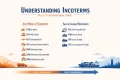
All 11 Incoterms Explained
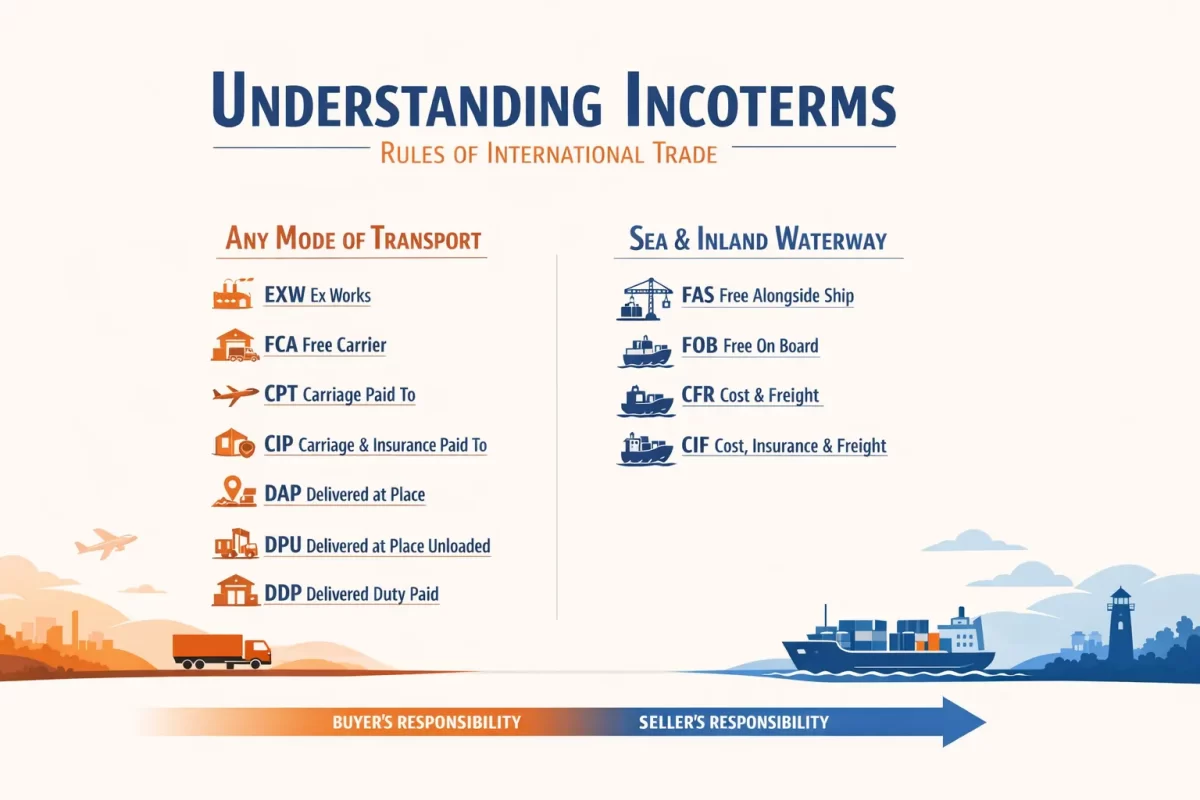
The ICC defines 11 Incoterms under its 2020 framework. These are divided into two groups: terms applicable to any mode of transport, and those used specifically for sea transport.
Rules for Any Mode of Transport
EXW (Ex Works)
The seller makes the goods available at their premises. The buyer handles everything else — transportation, export clearance, shipping, and insurance. This is the minimum responsibility for the seller.
FCA (Free Carrier)
The seller delivers the goods to a carrier chosen by the buyer at a specified location. Once handed over, the risk transfers to the buyer. This is widely used for container shipments.
CPT (Carriage Paid To)
The seller pays for transportation to a named destination. However, risk transfers to the buyer as soon as the goods are handed to the first carrier.
CIP (Carriage and Insurance Paid To)
Similar to CPT, but the seller also provides insurance coverage. Despite this, risk still transfers early, at the point of carrier handover.
DAP (Delivered at Place)
The seller delivers the goods to a specified destination. The buyer handles import clearance, duties, and unloading.
DPU (Delivered at Place Unloaded)
The seller is responsible for delivering and unloading the goods at the destination. This is the only Incoterm where unloading is the seller’s responsibility.
DDP (Delivered Duty Paid)
The seller takes full responsibility, including shipping, insurance, export and import clearance, and payment of duties and taxes. This is the maximum obligation on the seller.
Rules for Sea and Inland Waterway Transport
FAS (Free Alongside Ship)
The seller places the goods alongside the vessel at the port. From that point onward, the buyer takes over responsibility and risk.
FOB (Free On Board)
The seller handles export clearance and loads the goods onto the vessel. Risk transfers to the buyer once the goods are on board.
CFR (Cost and Freight)
The seller pays for transportation to the destination port, but risk transfers once the goods are loaded onto the vessel at the origin port.CIF (Cost,
Insurance and Freight)
Similar to CFR, but the seller also provides insurance. However, risk still transfers at the point of loading.
Choosing the Right Incoterm
Selecting the right Incoterm is a strategic decision.
New exporters often prefer FCA or FOB, as these allow control up to the export stage without taking on complex international obligations. More experienced exporters may use CIF or DAP to offer a more complete service to buyers. For high-value goods, CIP is often preferred due to added insurance coverage. DDP is typically used when the seller wants to provide a fully seamless experience, though it requires handling foreign regulations.
Final Thought
Incoterms may seem like simple three-letter codes, but they define the entire structure of an international trade transaction. They determine costs, responsibilities, and risk at every stage.
In global trade, clarity is everything. And often, the success of a deal depends on choosing the right three letters.