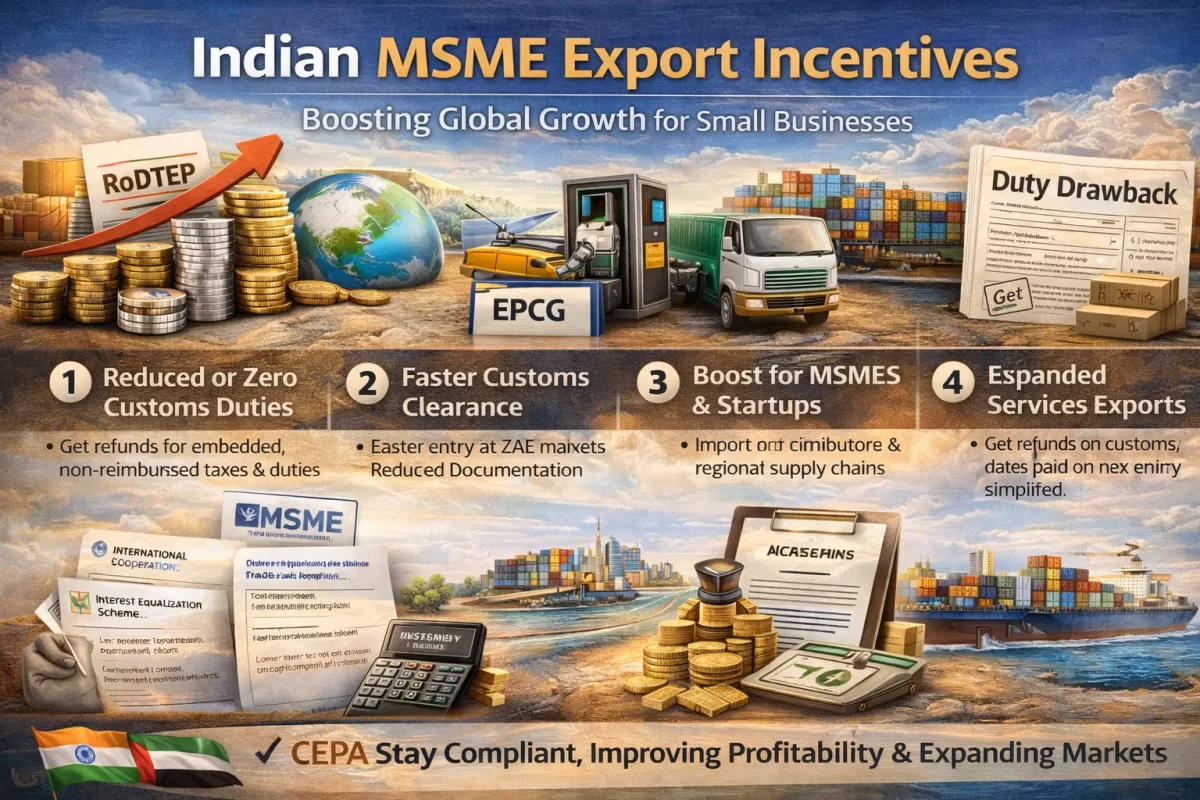
India’s MSME sector plays a vital role in the country’s export ecosystem. To help these enterprises compete globally, the Government of India offers a range of export incentives, financial support schemes, and policy benefits that reduce costs, improve competitiveness, and encourage international expansion.
Understanding these incentives can significantly improve profitability and make global trade more accessible for MSMEs.
Why Export Incentives Matter for MSMEs
Exporting involves additional costs—logistics, compliance, certifications, and marketing. Incentive schemes help MSMEs:
- Offset operational expenses
- Improve price competitiveness in global markets
- Reduce financial risk
- Strengthen cash flow
These benefits enable smaller businesses to compete with larger global players.
1. RoDTEP Scheme (Remission of Duties and Taxes on Exported Products)
The Remission of Duties and Taxes on Exported Products (RoDTEP) scheme refunds embedded taxes and duties that are not otherwise reimbursed.
Benefits for MSMEs:
- Refund of hidden taxes on exported goods
- Direct improvement in profit margins
- Available across many product categories
This scheme makes Indian goods more price-competitive internationally.
2. EPCG Scheme (Export Promotion Capital Goods)
Under the Export Promotion Capital Goods Scheme (EPCG) scheme, exporters can import capital goods at zero customs duty.
Benefits for MSMEs:
- Lower cost of machinery and technology upgrades
- Enhanced production capacity and quality
- Boost in long-term export competitiveness
3. Duty Drawback Scheme
The Duty Drawback Scheme provides refunds on customs duties paid on inputs used to manufacture exported goods.
Benefits for MSMEs:
- Reduced input costs
- Improved export pricing
- Better cash flow through duty refunds
4. MSME-Specific Support Schemes
The Ministry of Micro, Small and Medium Enterprises offers additional support:
- International Cooperation Scheme – Financial assistance for trade fairs and buyer-seller meets
- Market Development Assistance (MDA) – Support for overseas marketing efforts
- ZED Certification Support – Subsidy for quality certification to meet global standards
These schemes help MSMEs build credibility and global visibility.
5. Interest Equalization Scheme
The Interest Equalization Scheme provides interest subsidies on export credit.
Benefits:
- Lower borrowing costs
- Easier working capital access
- Reduced financial burden during export cycles
6. SEZ & EOUs Benefits
MSMEs operating under Special Economic Zones (SEZ) or as Export Oriented Units (EOUs) can enjoy:
- Tax benefits
- Duty-free imports
- Simplified customs procedures
These zones create an export-friendly ecosystem for growth-focused enterprises.
7. Logistics & Marketing Assistance
Several state and central government bodies provide:
- Freight assistance for selected products
- Support for export packaging and branding
- Grants for digital export marketing
This reduces the burden of entering and promoting in new markets.
How MSMEs Can Maximize These Incentives
To fully benefit, MSMEs should:
✔ Maintain accurate export documentation
✔ Stay updated on scheme eligibility and updates
✔ Work with export consultants or training programs
✔ Ensure compliance with DGFT, customs, and GST norms
Conclusion
Export incentives are powerful tools that help Indian MSMEs move from local success to global presence. By leveraging these schemes strategically, small businesses can reduce costs, improve margins, and compete confidently in international markets.
With the right awareness and compliance, export incentives can transform MSMEs into strong global players.