The Comprehensive Economic Partnership Agreement (CEPA) between India and the United Arab Emirates is a landmark trade agreement designed to strengthen economic ties, reduce trade barriers, and create massive opportunities for businesses on both sides. For Indian exporters, CEPA is more than a policy—it’s a gateway to faster market access, lower costs, and stronger global competitiveness.
What is CEPA?
CEPA is a bilateral trade agreement that reduces or eliminates customs duties, simplifies trade procedures, and promotes investment and services trade between participating countries. The India–UAE CEPA aims to boost bilateral trade to new heights by making cross-border business smoother and more profitable.
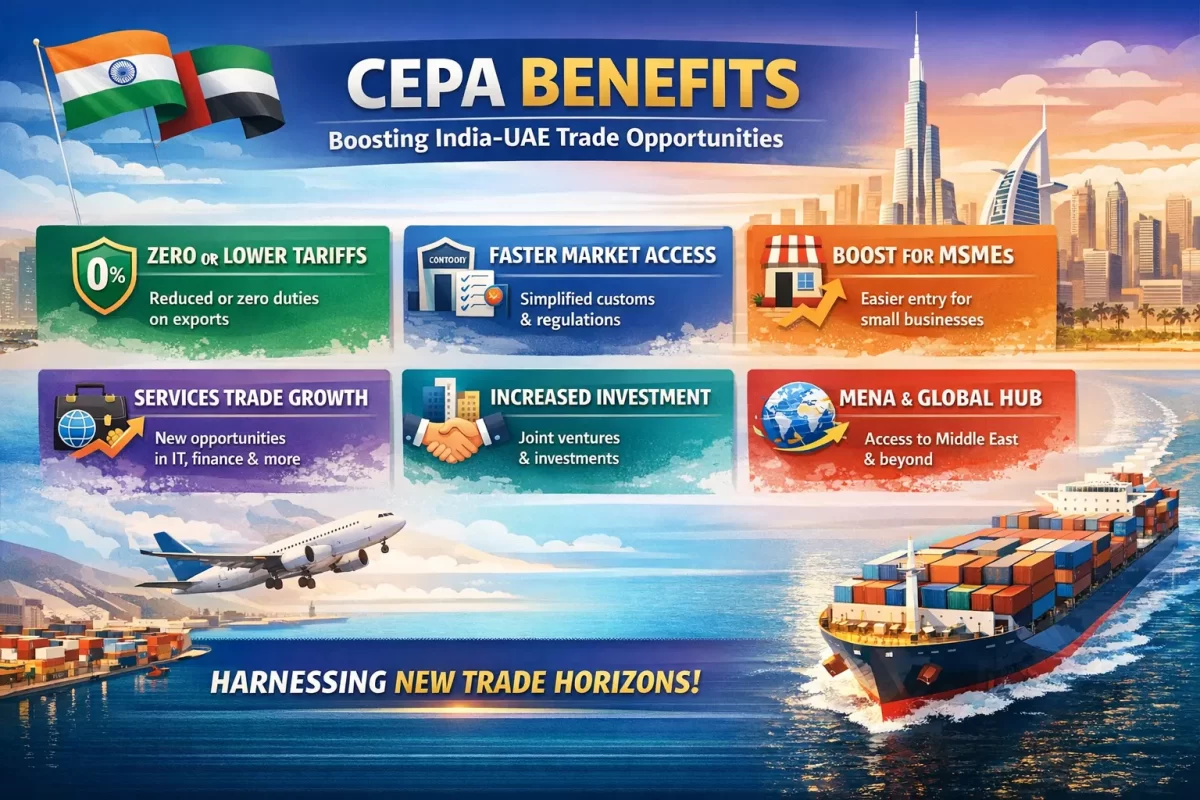
1. Reduced or Zero Customs Duties
One of the biggest advantages of CEPA is preferential tariff access.
Indian exporters benefit from:
- Lower or zero import duties on thousands of product categories in the UAE
- Improved price competitiveness compared to non-CEPA countries
- Higher profit margins or better pricing power in international markets
This is especially beneficial for sectors like textiles, gems & jewellery, food products, engineering goods, and chemicals.
2. Faster Market Access
CEPA simplifies regulatory procedures and reduces trade friction.
Exporters experience:
- Faster customs clearance
- Streamlined documentation requirements
- Reduced technical barriers to trade
This helps businesses enter the UAE market more quickly and respond faster to buyer demand.
3. Boost for MSMEs and Startups
Small and medium enterprises gain significantly from CEPA:
- Easier entry into a high-income consumer market
- Lower trade costs improve competitiveness
- Better access to distributors and regional supply chains
The UAE also serves as a gateway to the wider MENA region, multiplying growth potential.
4. Services Export Opportunities
CEPA is not limited to goods—it strongly supports services trade.
Indian professionals and firms in:
- IT & software
- Financial services
- Healthcare
- Education
- Consultancy
can benefit from easier market entry, professional mobility, and reduced regulatory barriers.
5. Increased Investment & Business Collaboration
CEPA encourages:
- Joint ventures between Indian and UAE companies
- Cross-border investments
- Technology transfer and partnerships
This opens doors for Indian businesses to scale internationally with local partnerships.
6. Simplified Rules of Origin
To claim CEPA benefits, goods must meet Rules of Origin criteria. The agreement provides:
- Clear product origin guidelines
- Transparent certification processes
- Reduced ambiguity in compliance
This ensures genuine exporters receive tariff benefits without unnecessary hurdles.
7. Strategic Trade Advantage
The UAE is a major re-export hub. By entering through the UAE, Indian exporters gain:
- Access to Middle East, Africa, and European markets
- Strong logistics infrastructure
- Global trade connectivity
Why CEPA Matters for Indian Exporters
CEPA helps businesses:
✔ Reduce export costs
✔ Improve global price competitiveness
✔ Expand into high-potential international markets
✔ Diversify export destinations beyond traditional regions
✔ Build long-term global trade presence
Conclusion
The India–UAE CEPA is a powerful tool for exporters ready to think globally. Businesses that understand and strategically use CEPA provisions can achieve faster growth, higher profitability, and stronger international positioning.
For Indian MSMEs and professionals, CEPA isn’t just a trade agreement—it’s a growth accelerator into global markets.