Exporting from India offers massive growth opportunities—but only when done compliantly. India’s export framework is structured, documentation-heavy, and policy-driven. Understanding compliance is not just about avoiding penalties; it’s about ensuring smooth customs clearance, faster payments, and long-term global credibility.
What is Export Compliance?
Export compliance refers to following all legal, regulatory, documentation, taxation, and banking requirements set by Indian authorities when exporting goods or services.
Key regulators involved include:
- Directorate General of Foreign Trade (DGFT) – Issues exporter registration and policy guidelines
- Central Board of Indirect Taxes and Customs (CBIC) – Governs customs procedures
- Reserve Bank of India (RBI) – Regulates export payments and foreign exchange
- Goods and Services Tax (GST) authorities – Handle export taxation compliance
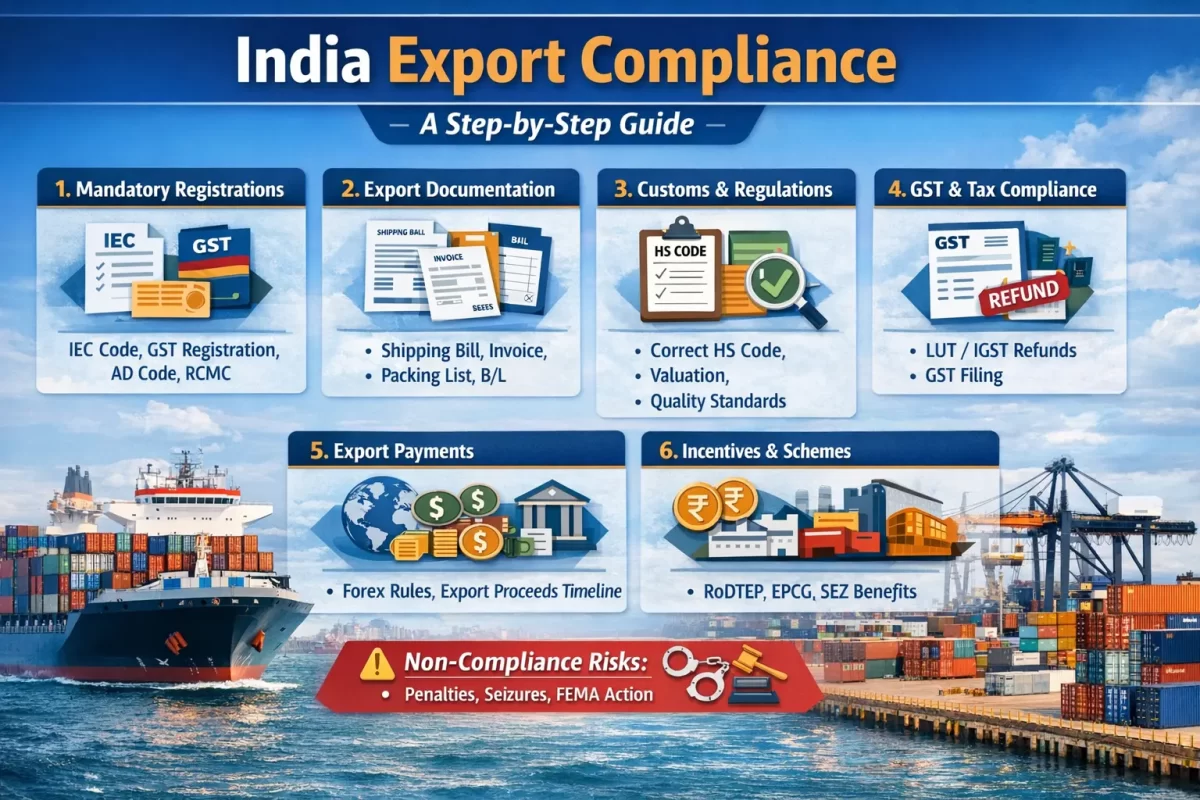
1. Mandatory Registrations for Exporters
Before exporting, businesses must obtain:
- IEC (Importer Exporter Code) from DGFT – A primary license for export/import
- GST Registration – Required even for zero-rated exports
- AD Code Registration – Bank authorization for export proceeds
- RCMC (Registration Cum Membership Certificate) – From relevant export promotion council (if applicable)
Without these, shipments cannot legally move through customs.
2. Key Export Documentation
Export paperwork must be precise. Errors cause shipment delays, penalties, or payment issues.
Core Documents Include:
- Shipping Bill – Customs clearance document filed electronically
- Commercial Invoice – Details buyer, seller, goods, value, currency
- Packing List – Item-wise shipment breakdown
- Bill of Lading / Airway Bill – Transport document issued by carrier
- Certificate of Origin – Proves goods are manufactured in India
Export Declaration Forms as required by RBI
3. Customs & Regulatory Compliance
Indian exports are governed under the Customs Act and Foreign Trade Policy.
Exporters must ensure:
- Correct HS Code classification of goods
- Proper valuation of goods
- No export of restricted or prohibited items without license
- Compliance with quality standards and certifications (BIS, FSSAI, APEDA, etc., depending on product
4. GST & Tax Compliance for Exports
Exports from India are zero-rated under the GST Act, but procedural compliance is required.
Exporters can choose:
Option A – Export under LUT (Letter of Undertaking)
Option B – Pay IGST and claim refund later
5. Foreign Exchange & Payment Compliance
The RBI regulates export proceeds under FEMA rules.
- Receive payment in foreign currency through authorized banks
- Realize export proceeds within permitted timelines (usually 9 months)
- File Export Declaration Forms (EDF)
- Ensure correct purpose codes in bank documentationExporters must:
Failure can lead to FEMA violations and banking restrictions.
6. Export Incentives & Scheme Compliance
To claim government benefits, compliance is critical.
Popular schemes include:
- Remission of Duties and Taxes on Exported Products (RoDTEP)
- Export Promotion Capital Goods Scheme (EPCG)
- Special Economic Zones (SEZ) benefits
Improper documentation can result in rejection of incentives.
7. Compliance for Export of Services
Service exporters must ensure:
- Proper service agreements with overseas clients
- Invoicing in foreign currency
- Receipt through banking channels
- Compliance with Place of Supply rules under GST
- Filing SOFTEX forms (for IT/software exports)
Risks of Non-Compliance
Ignoring export regulations can lead to:
- Shipment seizure or delays
- Financial penalties and fines
- Cancellation of IEC
- Loss of export incentives
- FEMA investigations
Compliance protects both reputation and revenue.
Why Export Compliance Matters
Strong compliance ensures:
- Faster customs clearance
- Smooth international payments
- Eligibility for government incentives
- Credibility with global buyers
- Sustainable, scalable export growth
Conclusion
Export compliance is not just paperwork—it is the foundation of successful global trade. Businesses that invest in understanding and implementing proper export procedures operate with confidence, reduce risk, and unlock the full potential of international markets.