The proposed India–New Zealand Free Trade Agreement (FTA) 2025 represents a significant step toward strengthening economic cooperation between two dynamic and complementary economies. As both nations explore deeper trade integration, the agreement is expected to enhance bilateral trade, improve market access, and create new opportunities for businesses across goods and services sectors. For Indian exporters, the India–New Zealand FTA 2025 offers a promising gateway to a developed, stable, and high-value market with strong demand for quality products and professional services.
Overview of the India–New Zealand FTA 2025
The India–New Zealand FTA is expected to cover trade in goods, services, investments, and regulatory cooperation. The agreement aims to reduce tariff and non-tariff barriers, streamline customs procedures, and encourage bilateral investments and supply chain collaboration.
By strengthening ties with New Zealand, India can further diversify its export destinations and expand its presence in the Asia-Pacific region, complementing its broader global trade strategy.
Key Benefits for Indian Exporters
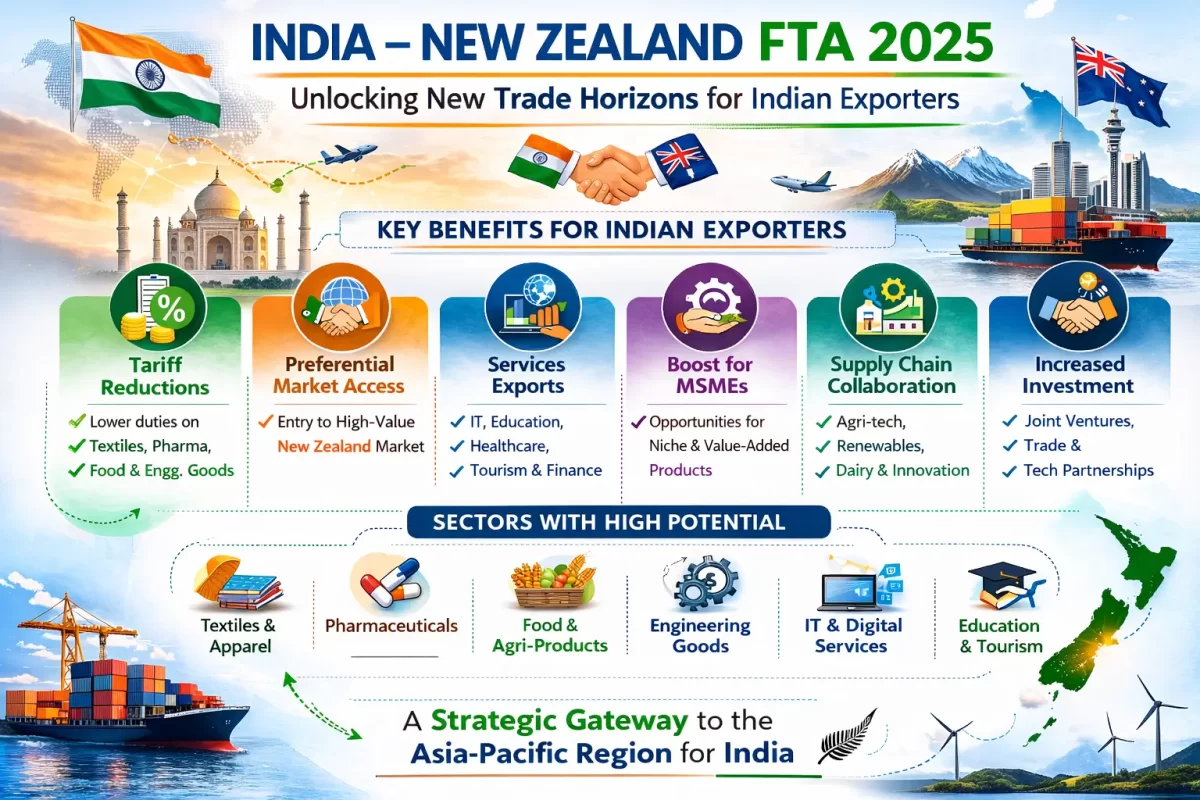
1. Tariff Reductions and Preferential Access
One of the major expected advantages of the India–New Zealand FTA is the reduction or elimination of tariffs on several Indian exports entering the New Zealand market. This will improve price competitiveness and enable Indian exporters to expand in sectors such as:
- Textiles and apparel
- Engineering goods and auto components
- Pharmaceuticals and chemicals
- Processed food and agricultural products
- Leather and handicrafts
Preferential access will allow Indian products to compete more effectively with suppliers from other countries.
2. Access to a Stable and High-Value Market
New Zealand is a developed economy with strong purchasing power, transparent regulatory systems, and a reputation for high-quality imports. The FTA will provide Indian exporters with easier entry into this premium market, encouraging businesses to upgrade product standards, packaging, and sustainability practices.
3. Growth Opportunities for Services Exports
India’s services sector stands to gain significantly from the proposed agreement. Opportunities are expected across:
- Information Technology and digital services
- Education and skill development services
- Healthcare and wellness services
- Tourism and hospitality services
- Professional consulting and financial services
Improved mobility provisions and regulatory cooperation can help Indian professionals and service firms expand their footprint in New Zealand.
4. Boost for MSMEs and Niche Exporters
The India–New Zealand FTA will create new opportunities for MSMEs and niche exporters to access a relatively less crowded but high-quality market. Indian small businesses can leverage the agreement to export value-added products, specialty goods, and innovative solutions tailored to New Zealand’s consumer preferences. This will help diversify India’s export base and enhance MSME participation in global trade.
4. Boost for MSMEs and Niche Exporters
The India–New Zealand FTA will create new opportunities for MSMEs and niche exporters to access a relatively less crowded but high-quality market. Indian small businesses can leverage the agreement to export value-added products, specialty goods, and innovative solutions tailored to New Zealand’s consumer preferences.
This will help diversify India’s export base and enhance MSME participation in global trade.
5. Strengthening Supply Chains and Sectoral Collaboration
The agreement is likely to promote deeper collaboration in complementary sectors such as:
- Agriculture and food processing
- Renewable energy and sustainability technologies
- Dairy technology and agri-tech innovation
- Education and research partnerships
These collaborations will enhance supply chain resilience and open pathways for joint ventures, technology transfer, and co-development initiatives.
6. Increased Investment and Bilateral Cooperation
The India–New Zealand FTA is expected to encourage two-way investments and business partnerships. Indian companies may explore distribution networks and market presence in New Zealand, while New Zealand firms may increase sourcing, investment, and innovation collaborations in India.
This will foster a stronger ecosystem of cross-border trade and investment.
7. Contribution to India’s Export Diversification Strategy
The agreement aligns with India’s broader objective of diversifying export markets and reducing dependence on a limited number of trading partners. Strengthening trade relations with New Zealand will help India expand its presence in the Asia-Pacific region and integrate more deeply into global value chains. Such diversification is essential for achieving long-term, sustainable export growth.
Challenges and Strategic Considerations
While the India–New Zealand FTA presents strong opportunities, exporters must also focus on:
- Meeting stringent quality, safety, and sustainability standards
- Understanding consumer preferences in a smaller but premium market
- Ensuring efficient logistics and distribution channels
Businesses that prioritize quality assurance, compliance, and targeted market research will be best positioned to leverage the benefits of this agreement.
Conclusion
The India–New Zealand FTA 2025 is set to open new avenues for Indian exporters in a stable and high-value Asia-Pacific market. With expected tariff reductions, enhanced services access, and deeper sectoral collaboration, the agreement will strengthen bilateral trade and create sustainable growth opportunities.